The Way of the Warrior: Discovering Việt Võ Đạo with Master Phuc
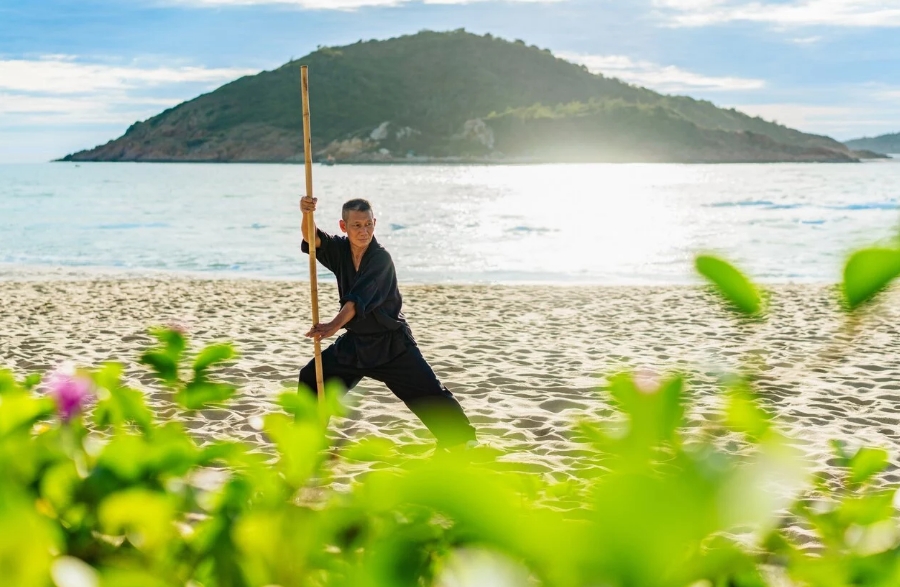
Binh Dinh Province, Vietnam, November 14, 2026 / TRAVELINDEX / Where Korea has taekwondo and Japan has karate, Vietnam has Việt Võ Đạo. At Anantara Quy Nhon Villas, in Vietnam’s martial-arts-mad Bình Định province, now part of Gia Lai province, the tradition announces itself to arriving guests with the steady beat of traditional drums as Tran Van Phuc, the resort’s martial arts master and security manager, steps forward to begin his demonstration.
The famed flying scissor takedown, widely regarded as the most dramatic of Việt Võ Đạo’s 26 signature movements, looms large in the discipline’s lore. Phuc’s demonstration, however, focuses less on spectacle than on the essence of the art: stillness yielding to speed, restraint to force, precision to explosive movement.
For Phuc, who combines the roles of the resort’s security manager and master of Việt Võ Đạo, the path of the warrior was once a solitary, stolen thing. He began training at fifteen, concealing his passion from his parents. Even after winning his first major competition at nineteen, he said nothing of the trophy he brought home. The years that followed would bring countless national titles and widespread recognition, but the art first took root in private.
“I grew up with martial arts right on my doorstep and was fascinated from such a young age. I love the feeling of release and form of expression that Việt Võ Đạo gives and it is a hugely important part of who I have become as a person.”
Việt Võ Đạo, founded in 1936, is an art of absolute presence. It balances ten unarmed combat forms for striking and grappling with sixteen forms that employ a simple bamboo staff. It requires complete presence, suspending the practitioner in the pure geometry of the movement.
“The minute I start, my mind becomes solely focused on the art, the moves and the emotional depth it gives me.”
This intense mental focus is matched by a deep desire to share the art with the uninitiated. For many years, Phuc began his early-morning sessions at the resort with a peculiar, phonetically charming greeting: “Family, see”. Though his English has since grown more polished, the underlying truth of that phrase remains the cornerstone of his teaching philosophy. He believes that every technique, like every human being, is part of a larger, interconnected lineage.
“Like family, even extended family is connected, so the moves are also connected – each move leads seamlessly into the next one to create the whole experience.”
This sense of connection allows him to adapt his mastery to any audience. For the younger guests who arrive at the resort eager to mimic their screen heroes, he reaches for the playful, accessible world of Kung Fu Panda. Yet, whether teaching a child to handle a bamboo stick with care or guiding an adult through the rigorous physical demands of the forms, he insists on practising in the open air. He rejects the sterile walls of an indoor studio, preferring to stand where the wind, the sun and the salt can test the resolve of his students.
“The arts have traditionally been practiced outdoors since its inception. It’s a good way to harden your will and your skin under the natural elements, plus we are staying true to its roots.”
It is an observation that could apply equally to Phuc himself. Between sea and mountains, he has found a way to offer visitors a glimpse of his homeland through a tradition that has shaped both his life and his province. In sharing Việt Võ Đạo, he invites guests into a culture, a history and a way of seeing the world in which every movement, like every person, is connected to something larger.